
One of the most overlooked drivers of poor outcomes in sickle cell disease isn’t biology.
It’s health literacy.
Health literacy is the ability to find, understand, and use health information to make informed decisions. When patients lack this knowledge, the consequences ripple through the entire healthcare system.
Research shows that limited health literacy is linked to:
- Higher emergency department use
- Increased hospitalizations
- Poor medication adherence
- Greater complications and mortality
- Billions in avoidable healthcare costs annually
For people living with sickle cell disease, the stakes are even higher.
Managing this condition requires understanding hydration, oxygenation, triggers of vaso-occlusion, medication options like Hydroxyurea, and when to seek care before a crisis escalates.
When patients aren’t equipped with clear, accessible information, they are often left reacting to complications instead of preventing them.
The result?
More pain crises.
More hospital admissions.
More financial strain for families and healthcare systems alike.
But when patients are educated and empowered, outcomes improve.
Studies in patient blood management, chronic disease education, and community health programs consistently show that informed patients use fewer emergency services, experience better quality of life, and participate more actively in their care decisions.
Health literacy is not a luxury.
It is a public health intervention.
Investing in patient education for sickle cell disease isn’t just compassionate care.
It’s cost-effective, evidence-based healthcare strategy.
When we raise health literacy, we lower suffering.
And we lower costs.
#SickleCellDisease #HealthLiteracy #PatientEducation #PublicHealth #HealthEquity
Many of the complications that trigger transfusion are partially preventable or modifiable with better disease management.
Education helps patients:
- Prevent dehydration and hypoxia
- Treat infections earlier
- Recognize early crisis symptoms
- Adhere to disease-modifying therapy
- Avoid environmental triggers
When patients intervene earlier, crises are less likely to escalate to the point where transfusion becomes necessary.
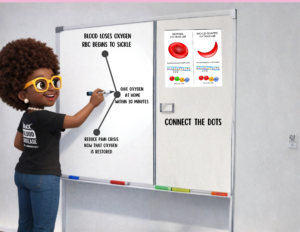
Did you know a crucial finding was discovered then ignored for nearly a century in treating sickle cell disease?
1927 experiment by William Hahn and Elizabeth Gillespie showing that low oxygen (deoxygenation) triggers sickling of red blood cells.
Key study
- William Hahn and Elizabeth Gillespie (1927)
- Demonstrated that removing oxygen from blood samples caused red cells from sickle cell patients to become sickle-shaped, while restoring oxygen reversed the shape change.
What they actually did
- They observed that distorted sickle cells could return to normal shape when oxygen was present.
- They then exposed blood to gases without oxygen (or high CO₂).
- Under those low-oxygen conditions, the red cells consistently sickled.
This experiment established a foundational principle of sickle cell pathophysiology:
Deoxygenation → hemoglobin S polymerization → red cell sickling.